
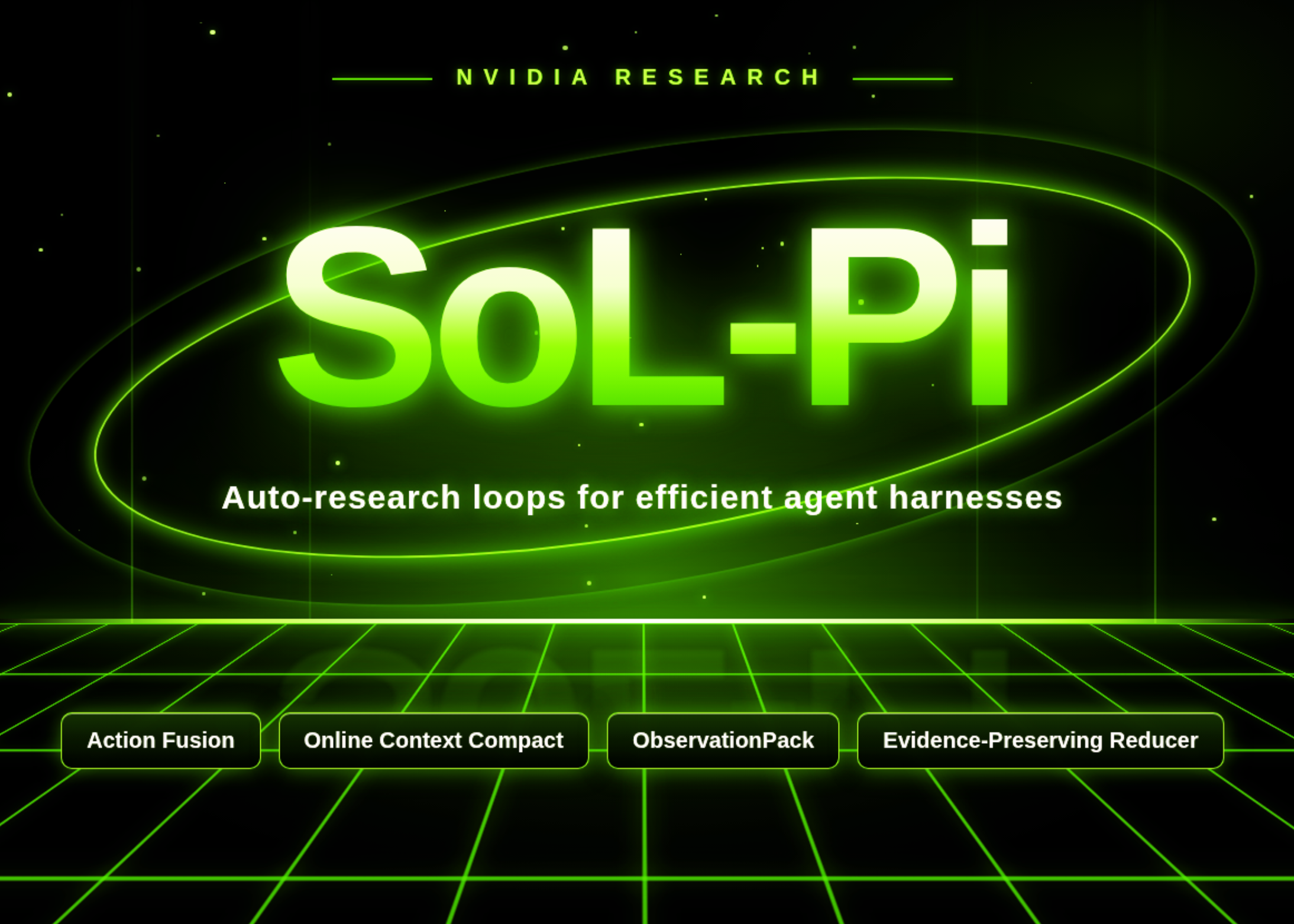

Coding agents now run for hours, not minutes. Every edit, test run and log read goes back into the model’s context. A team of researchers from NVIDIA, NTU and MIT have released SoL-Pi, a set of 4 efficiency mechanisms for the open-source Pi coding agent. An AI found these mechanisms by running auto-research loops at the harness layer. On the 51-task EdgeBench evaluation, SoL-Pi cuts recorded token traffic by 44.7% to 49.0% versus Pi and cuts API cost by roughly 33%. Its scores stay close to Pi on both GPT-5.6 Sol and Opus 5.
Is it deployable? Yes. SoL-Pi ships on GitHub under NVlabs as an MIT-licensed extension that runs on an unmodified Pi release. It is tested with Pi 0.85.1 and Node.js 22.19 or newer.
Why Target the Harness
Most efficiency work lowers the cost per token through faster kernels, quantization or cheaper models. SoL-Pi instead reduces how many tokens a task consumes. The harness is the layer that handles tool calls, context, observations and delegation.
Tuning a harness by hand is slow, and its parts are coupled: a fix in one place can push cost into later steps. Meta-Harness and similar systems automate this work. However, a recent study found that evolved harnesses can overfit their search tasks and give only marginal gains on unseen ones.

How the Search Works
A research AI observes execution traces from a separate agent running base Pi. It then proposes harness changes and tests them. The search covered:
- 152 proposed directions across 6 families: context, progress, tools, delegation, prompt and policy, and improvement and evaluation
- 535 executable environments: 495 built from GitHub issue-pull request pairs and 40 synthetic tasks with executable verifiers
- More than 3,000 runs and 60,000+ agent-environment interactions
Each search is a disposable, isolated loop. It follows the autoresearch cycle, extended with a Ralph Loop implementation step and an independent reviewer.
Acceptance rules are fixed before the search starts, and the optimizer cannot change them. Every capability metric must stay within a predeclared tolerance. The candidate must also improve at least 1 efficiency metric. EdgeBench stays held out. Of its 51 public tasks, 11 are used for one-way acceptance of frozen candidates and 40 for final evaluation. Held-out results never feed back into the search.
The 4 Mechanisms That Survived
Results on EdgeBench
The full stack was built on GPT-5.6 Sol and moved to Opus 5 without further search. On Opus 5, it keeps 94.3% of Pi’s score while cutting token traffic by 44.7% and API cost by 33.5%. On GPT-5.6 Sol, it keeps 93.7% of Pi’s score with 49.0% fewer tokens and 33.2% lower cost.
The Performance point uses the best single mechanism for each backend: ObservationPack on GPT-5.6 Sol and Action Fusion on Opus 5. It lifts scores 5.3% and 12.8% above Pi.
On GPT-5.6 Sol, the full stack increases cache-write traffic from 0.0141 B to 0.0316 B tokens. Total cost still falls, from $1,339 to $894. The paper estimates hourly savings of $8.75 to $13.50 versus the native Codex and Claude Code harnesses, and $4.36 to $5.71 versus Pi.
Beyond EdgeBench
- Terminal-Bench 4 (63 CPU-only tasks): SoL-Pi solves 15 tasks versus 18 for both Codex and Pi. It lowers total cost by 26.3% versus Pi ($211.12 vs $286.45).
- IMO 2026, Lean 4-verified: SoL-Pi passes 3 of 6 problems, matching Pi, at the lowest cost per passed problem ($20.90). Codex passes 5.
- Agent swarm: A Codex coordinator with 20 SoL-Pi workers reaches 1,127 cycles at $60.11. With 20 Pi workers, it reaches 1,366 cycles at $82.12. A single Codex agent is still the cheapest option at $39.20 and reaches 1,333 cycles.
The research team calls the cross-model transfer preliminary. The mechanisms trigger less often on Opus 5, possibly because the search used only GPT-5.6 Sol trajectories.
Key Takeaways
- SoL-Pi cuts EdgeBench token traffic by 44.7% to 49.0% versus Pi.
- API cost drops about 33% while keeping about 94% of Pi’s average score.
- The 4 mechanisms survived a search over 152 directions and 535 environments.
- SoL-Pi is an MIT-licensed, opt-in Pi extension on GitHub.
Check out the Paper, GitHub Repo and Technical Blog. All credit goes to the researcher of this project. Also, feel free to follow us on Twitter and don’t forget to join our 150k+ML SubReddit and Subscribe to our Newsletter. Wait! are you on telegram? now you can join us on telegram as well.
Need to partner with us for promoting your GitHub Repo OR Hugging Face Page OR Product Release OR Webinar etc.? Connect with us
Asif Razzaq is the CEO of Marktechpost AI Media Inc.. As a visionary entrepreneur and engineer, Asif is committed to harnessing the potential of Artificial Intelligence for social good. His most recent endeavor is the launch of an Artificial Intelligence Media Platform, Marktechpost, which stands out for its in-depth coverage of machine learning and deep learning news that is both technically sound and easily understandable by a wide audience. The platform boasts of over 2 million monthly views, illustrating its popularity among audiences.