
Despite the “dot-com crash” in 2000, the tech industry remained an attractive career destination for many who believed technology represented the future. The digital age — defined by global connectivity and computers — had firmly taken hold, and over time, the tech industry emerged as a dominant force in the labor market. High-paying jobs for engineers, designers, and professionals across a wide range of fields became increasingly common.
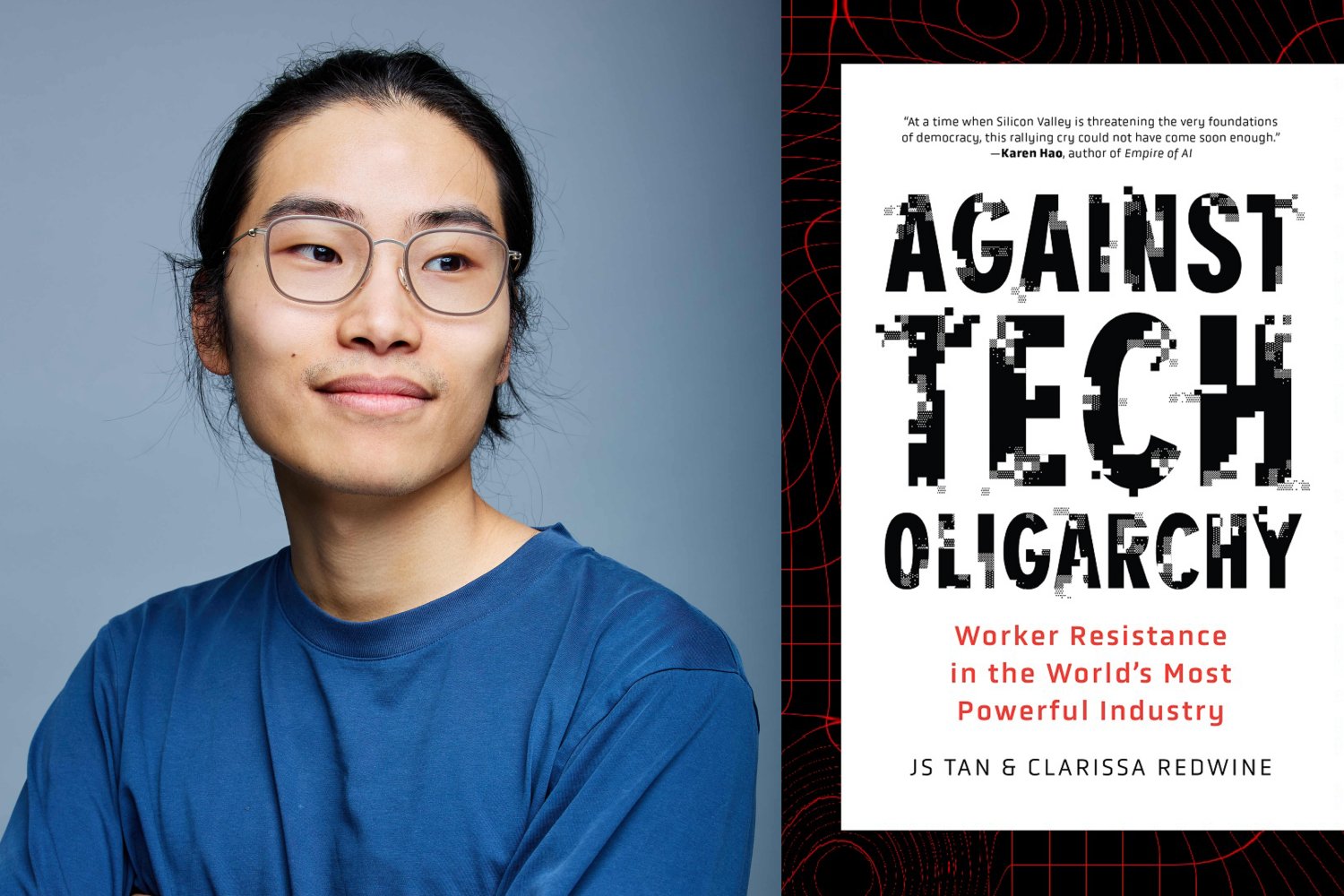
MIT PhD student JS Tan SM ’22 was among those who, upon graduating from Brown University and Rhode Island School of Design in 2015, joined the tech industry.
“A lot of us had this idea that technology, and in particular the technologies related to the internet, had the potential for bringing about a more progressive version of the world,” Tan says.
Google echoed this ethos to its employees with its once-famous motto, “don’t be evil,” as their informal corporate philosophy and code of conduct guideline. They’ve since dropped the tagline.

But in time, particularly with the start of the first Trump administration, some tech industry employees found themselves questioning if their employers were really intent on supporting policies to support a more democratic world. According to Tan, their willingness to publicly oppose their employers’ actions — at first successfully — is currently experiencing an anti-worker backlash.
Now, Tan and his former tech industry colleague Clarissa Redwine have published a book on the rise and fall of the tech worker labor movement. “Against Tech Oligarchy: Worker Resistance in the World’s Most Powerful Industry” (Haymarket Books, 2026) chronicles how tech workers organized themselves, the effective strategies they used, and the effect the movement had on Silicon Valley labor politics over the past decade.
Documenting a movement from within
In 2017, Tan was working for Microsoft and Redwine for Kickstarter, when President Donald Trump signed an executive order suspending entry into the United States for nationals from seven predominantly Muslim countries for 90 days, and suspending Syrian refugees from entering the country indefinitely.
“As a whole, I think the tech sector really pushed back against this,” says Tan. “[OpenAI co-founder] Sam Altman participated in protests of this ban at the airport. In fact, the day before he joined these protests, he wrote in his blog that the tech industry needed to take a stand against the Trump administration, and particularly its immigration policies.”
Altman’s Jan. 28, 2017, blog post read, in part, “Tech companies go to extraordinary lengths to recruit and retain employees; those employees have a lot of leverage. If employees push companies to do something, I believe they’ll have to. At a minimum, companies should take a public stance. But talking is only somewhat effective, and employees should push their companies to figure out what actions they can take.”
Tan says Altman’s words inspired tech workers across the industry to publicly voice their opposition and “push for the values they believed in.” For the next several years, workers staged walkouts and protested their employers’ contracts with U.S. military and immigration enforcement agencies, as well as workplace policies they considered sexist.
“That was a time in which a lot of tech workers felt that their companies were walking back the values that they had initially promised,” says Tan.
Their objections initially met with some success. In 2018, following protests by Google employees, the company decided not to renew its contract for Project Maven, a Pentagon initiative using artificial intelligence to analyze drone surveillance footage. Nearly 4,000 employees signed an open letter to their CEO stating, “Google should not be in the business of war.”
Fast forward eight years. Earlier this year, more than 600 employees signed an open letter urging Google’s CEO to reject classified AI work with the Pentagon, citing concerns about potential uses including lethal autonomous weapons and domestic surveillance.
“The way Google responded to them this time was to say, basically, ‘Too bad, we’re committed to working with the Pentagon,’” says Tan. “So, there is this kind of shift as to how Google is positioning itself politically, as well as to their employees.”
What happened to the tech industry employee leverage?
Tan’s book outlines several events that he argues have negatively impacted their formerly strong influence. First, following interest rate hikes in 2022, the tech industry lost hundreds of billions in market valuation and set out to cut costs, the most significant of them being the expensive salaries of their employees. In other words, the labor market soured on tech workers, giving employers opportunity to wrest back control, Tan suggests.
Second, he points to the drastic effect of agentic AI coding systems on the nature of their work, arguing that these tools have deskilled workers and made everyone much more worried about job security.
“Tech workers had to face these shocks on their own. With a union or some ability to coordinate across workers and bargain as a group, they might’ve had more power to actually push back,” says Tan.
Documenting the past to support the future
Tan enrolled at MIT in 2020, earning a master’s degree at the MIT Media Lab. He is currently a doctoral student in the Department of Urban Studies and Planning with a focus on the political economy of the tech sector.
At various points in their careers, Tan and his co-author had been involved with organizing in the tech sector. Redwine was a prominent organizer in the union drive at Kickstarter. She was fired from the company in 2019; Redwine said her dismissal was retaliation for her organizing activity, while Kickstarter denied that claim. One reason Tan and Redwine wrote this book is because they saw that the bandwidth for labor organizing among tech workers had hit a new low.
“Tech workers want to have a say over the way their technologies are designed,” says Tan. “They want to be able to push for the right guardrails around technologies that they’re building. We wanted to use this book as an opportunity to analyze why it was that, within eight years, the tech worker movement had sort of fallen into this state of paralysis.”
They began writing the book in 2024, reliving the highs and lows of the past decade. This is Tan’s first book. He says writing it was an “exhilarating experience” and one that he profoundly enjoyed.
“It’s why, in part, I’m drawn to academia. To a large extent, I believe in the power of research and of writing. To have the opportunity to do this about a subject that I care deeply about has been an amazing experience.”
A book launch and discussion about “Against Tech Oligarchy,” co-hosted by the Department of Urban Studies and Planning, will take place on Oct. 26.