


Ripple and SBI announced the official launch of RLUSD in Japan on June 24, following JFSA approval, with the stablecoin available to institutional and retail users through SBI VC Trade.
Ripple categorized RLUSD under Japan’s Payment Services Act as a new type of electronic payment instrument for foreign-issued stablecoins, the first time the company has had a regulated dollar stablecoin in one of its most established markets.
The day after the launch, Circle and Nomura plan to launch a USDC-based digital asset settlement and corporate payment service in Japan as early as 2027.
The service would let Japanese businesses exchange yen for USDC for supplier payments, overseas affiliate transfers, and FX settlements, compressing cross-border transfers that currently take two to three business days down to minutes.

Japan’s FX market processed $440 billion in daily transactions in 2025, per BIS data, a figure that puts real institutional weight behind the announcement.
Japan’s FSA-registered electronic payment instrument list, as of June 24, shows SBI VC Trade handling USDC, RLUSD, and JPYSC.
SBI launched RLUSD with Ripple, distributed USDC from March 2025, and co-launched JPYSC the same week with SBI Shinsei Trust Bank overseeing issuance and Startale as technical partner.
Ripple’s longtime Japanese ally has built a stablecoin shelf, and every major issuer is on it.
Stablecoin / projectMain Japan partnerCurrency exposurePrimary laneStrategic implicationRLUSDRipple + SBI VC TradeUSDCross-border payments, remittances, Ripple Payments flowsRipple’s Japan relationship becomes a regulated dollar-stablecoin channelUSDCCircle + SBI VC Trade; future Nomura serviceUSDExchange access, corporate FX, supplier payments, overseas transfersCircle moves from listed access into institutional settlementJPYSCSBI VC Trade, SBI Shinsei Trust Bank, StartaleJPYLarge transfers, on-chain FX, institutional lending, RWA settlementSBI builds a yen-denominated stablecoin laneMegabank stablecoinsMUFG, SMBC, MizuhoJPYDomestic B2B settlement and bank-led paymentsInstitutional trust could dominate yen settlement by 2027
Ripple’s Japan position
SBI Group invested in Ripple in 2016; SBI Remit built remittance corridors on Ripple Payments after that investment; and XRP gained retail familiarity through SBI VC Trade at a depth unusual for any blockchain asset outside Japan.
RLUSD extends that decade-long relationship by being the first regulated dollar stablecoin distributed through SBI’s existing payment infrastructure.
Ripple said RLUSD has reached approximately $1.7 billion in market capitalization since its launch in late 2024. SBI VC Trade’s own notice positioned RLUSD as the platform’s second US dollar stablecoin, alongside USDC on the same shelf, with relationship history as the differentiator.
Cross-border payments, remittances, and Ripple Payments flows are where that history converts into actual transaction volume, and those lanes are Ripple’s most defensible position in Japan.
The institutional lane Circle and Nomura are opening
USDC arrived in Japan via SBI VC Trade in March 2025, with Binance Japan, bitbank, and bitFlyer signaling future listings, thereby enabling Circle to achieve exchange-level distribution.
The Nomura partnership brings USDC into corporate treasuries, supplier payment chains, and FX settlement desks within Japanese companies, a territory that exchange listings never reach.
A survey by Nomura and Laser Digital of 518 Japanese investment professionals found that 63% saw stablecoin use cases spanning treasury management, cross-border payments, crypto investment, and tokenized securities settlement.
The same survey found that stablecoins issued by major financial institutions received the highest trust ratings across JPY, USD, and EUR denominations.
Ripple positions RLUSD around payments, cross-border liquidity, and settlement infrastructure, the same institutional problem Nomura gives Circle a bank-facing route to solve, with the institutional trust layer that Ripple’s own brand alone has yet to earn in Japan’s corporate market.
The yen stablecoin floor
Reports pointed out that MUFG, SMBC, and Mizuho plan to jointly issue yen-based stablecoins during the fiscal year ending March 2027, with Japan’s FSA supporting the experimental phase.
That timeline runs in parallel with Circle and Nomura’s 2027 target and with JPYSC’s current distribution through SBI VC Trade.
SBI and Startale call JPYSC Japan’s first trust-type yen stablecoin under the electronic payment instruments framework.
It targets large-value transfers, on-chain FX, institutional lending, and tokenized RWA settlement, as well as corporate use cases in which a yen-denominated instrument carries less FX risk for Japanese firms than a dollar-denominated one.
For domestic B2B payments and yen-to-yen settlement flows, bank-issued yen stablecoins carry an institutional trust advantage that puts dollar stablecoins in a structurally weaker position.
If RLUSD drives meaningful transaction flow on cross-border corridors, connecting Japanese institutions to dollar liquidity faster than SWIFT rails, the SBI relationship converts from a distribution advantage into a revenue-generating payment infrastructure.
Ripple Payments already operates remittance corridors through SBI Remit, and RLUSD adds a regulated stablecoin layer on those rails that Circle, arriving through Nomura with a 2027 target, has yet to build operations in Japan.
The bear case is that RLUSD becomes a listed stablecoin without the transaction volume to support its position.
If Nomura activates USDC for corporate FX before Ripple deepens RLUSD usage beyond SBI VC Trade listings, and if megabank yen stablecoins absorb domestic settlement flows, RLUSD ends up serving the cross-border and crypto-settlement lane Ripple already held.
Meanwhile, the higher-value corporate settlement market consolidates around Nomura, Circle, and the megabanks.
SBI’s position and the adoption test
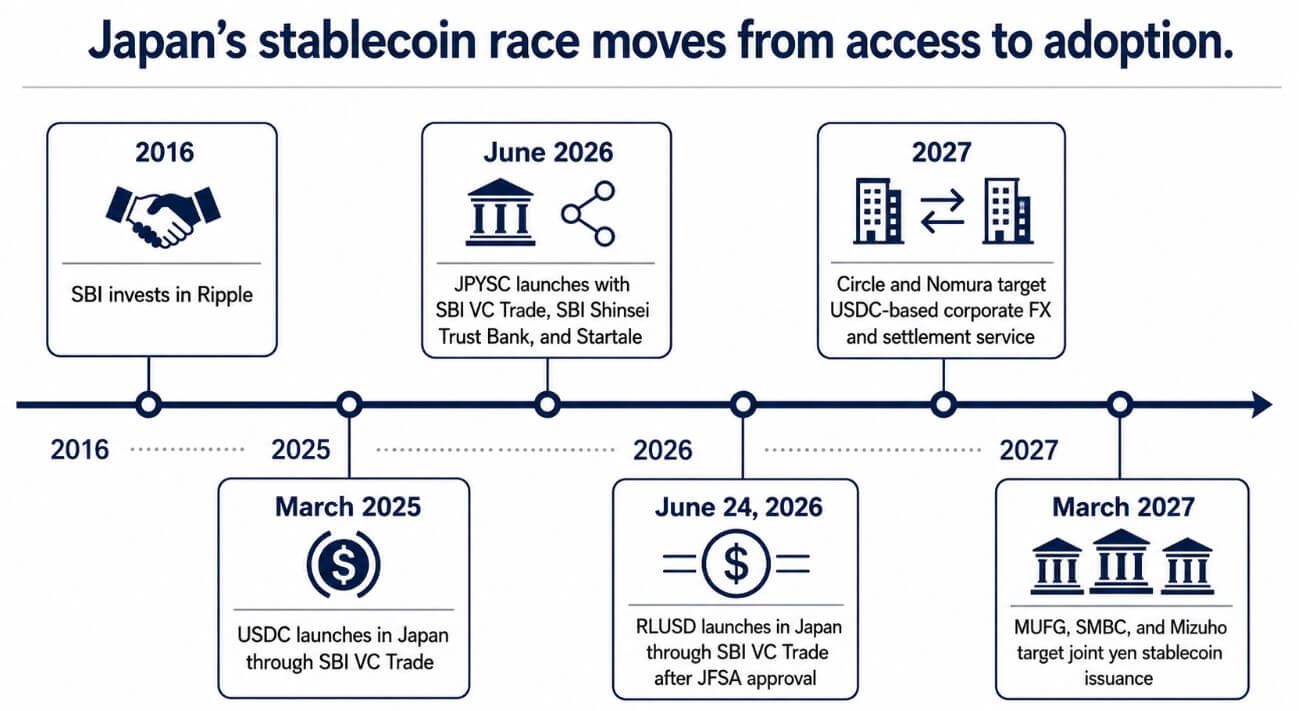
SBI invested in Ripple in 2016, distributed USDC in March 2025, launched RLUSD in June 2026, and co-launched JPYSC the same week.
The FSA list showing SBI VC Trade handling all three stablecoins simultaneously makes SBI’s actual Japan strategy visible: a regulated access layer for multiple issuers that captures distribution revenue regardless of which stablecoin wins each use-case lane.
SBI’s multi-stablecoin positioning gives Ripple guaranteed distribution and retail access through a regulated partner, and it puts Ripple in direct wallet-share competition with USDC and JPYSC on the same platform.
Four stablecoins now cover Japan’s regulated market: RLUSD on Ripple-rail and cross-border dollar liquidity; USDC on exchange access and Nomura-backed corporate FX; JPYSC on yen-denominated institutional flows; and megabank stablecoins targeting domestic settlement by March 2027.
Use-case laneLikely strongest contenderWhyRisk to RippleCross-border remittancesRLUSD / Ripple PaymentsRipple has SBI history and remittance infrastructureLow, unless USDC gains faster corporate adoptionCorporate FX settlementUSDC + NomuraNomura brings bank-facing trust and corporate distributionHigh, because it overlaps with Ripple’s settlement pitchDomestic B2B yen paymentsJPYSC / megabank stablecoinsYen instruments reduce FX risk for Japanese firmsHigh, because dollar stablecoins are structurally weaker for yen-to-yen flowsExchange liquidityUSDC and RLUSDBoth sit on SBI VC Trade’s regulated stablecoin shelfMedium, because listing alone does not prove transaction volumeTokenized securities / RWA settlementJPYSC / megabank stablecoins / USDCInstitutions may prefer bank-issued or bank-linked settlement assetsMedium to high, depending on whether RLUSD gains institutional railsCrypto-native settlementRLUSD / USDCDollar stablecoins are natural for crypto market liquidityMedium, because USDC has global scale
Ripple has the SBI relationship, remittance infrastructure, and a decade of XRP-adjacent brand familiarity that Circle and Nomura will spend years trying to replicate in Japan.
Circle has a dollar-stablecoin scale, a banking partner with institutional trust data, and a corporate FX pitch targeting the highest-value payment problem Japanese firms face.
Both enter the adoption phase without proven transaction volume in Japan, which will decide the market.
The next 18 months, ending around the Circle/Nomura and megabank 2027 launch targets, will determine whether Ripple’s head start converts into a durable position in payment infrastructure or whether Japan’s stablecoin market consolidates around institutional trust and bank distribution.